


.png?v=1k6n27q)
NEWS
.png?v=1k6n27q)
First Tests in Feldkirchen, Carinthia – Transport of the Robot
An important milestone in the CarryMeHome project was the transport of the demonstrator to Feldkirchen in Carinthia, where the first practical tests were carried out together with regional project partners. During a joint meeting, the robot was presented on site for the first time, providing an opportunity to showcase the project’s progress and discuss the next development steps.
The Carinthian partners were able to test the demonstrator themselves and gain firsthand experience of its functions and potential applications. These initial trials provided valuable insights and feedback that will support the further development and optimization of the system.
The visit also served as preparation for the Shopping Night on July 31 in Feldkirchen, where the project will be presented to a wider audience. The successful first tests marked an important step forward and laid the foundation for future demonstrations and the continued progress of the CarryMeHome project.
23.07.2026
Fotos: @Innovationszentrum W.E.I.Z.
,


Project Presentation as Part of the Digital Education Program at NMS 2 Weiz
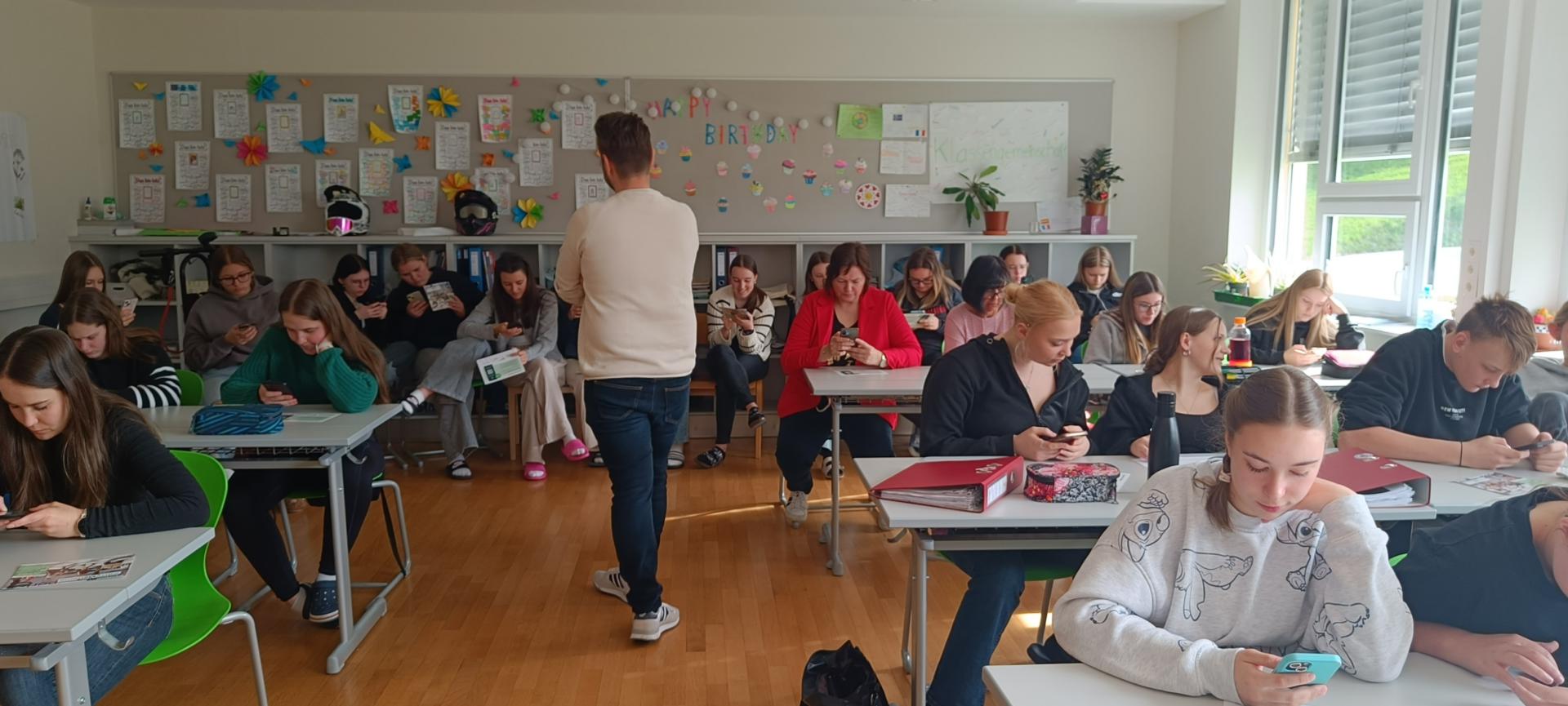
As part of the subject Digital Education at NMS 2 Weiz, where students are currently exploring the topics of autonomous and automated driving, the transport robot from the CarryMeHome project was presented.
The interested students gained valuable insights into the process of a research project, from the initial idea and development phase through to practical testing. In addition, the fundamentals and challenges of (semi-)autonomous driving were explained in an engaging way and discussed together.
It was particularly encouraging to see the students' strong interest, reflected in the many questions they asked and their active participation in the discussion. A special highlight was the opportunity to test the demonstrator themselves and experience its functions firsthand. This allowed the students to gain a practical insight into research and future technologies while learning more about innovative mobility solutions.
15.05.2026
Fotos: @Innovationszentrum W.E.I.Z.


CarryMeHome is opening the Long Night of Research
As part of the Long Night of Research, W.E.I.Z. Research & Development gGmbH opened its doors and presented innovative mobility solutions of the future to visitors. The highlight was the transport robot from the “CarryMeHome” research project, which demonstrated how short everyday journeys could be made more comfortable, sustainable, and at the same time remain an active mode of travel.
At the exhibition station, visitors gained fascinating insights into the development process behind the project. The research team explained how engineers, mobility researchers, and regional partners are working together to develop a transport robot that meets the needs and expectations of different user groups. From the initial concepts and design sketches, through technical challenges, to the first pilot tests in the city of Weiz, the entire development process was presented in an engaging and accessible way.
A particular highlight was the opportunity to experience the first demonstrator up close. Visitors were able to explore its initial capabilities and learn how modern sensor technology, electric assistance, and intelligent software interact to create an effective overall system. The project team not only presented the current state of development but also provided an outlook on upcoming milestones and challenges.
24.04.2026
Fotos: @Innovationszentrum W.E.I.Z.,

meinbezirk.jpg)

We Would Like to Thank the Participants of Our Survey and Congratulate the Winners
As part of the CarryMeHome project, a survey was conducted in Weiz to assess the acceptance of innovative mobility solutions. The aim was to gain a better understanding of people’s willingness to use a transport robot and to identify the travel distances that are most relevant for the potential use of such a solution.
Thanks to an accompanying prize draw featuring attractive prizes, the survey achieved a wide reach. In total, more than 300 people participated and provided valuable insights for the further development of the project.
We are delighted by the high level of participation and the strong interest in the project. We would like to sincerely thank all participants for their support and the many helpful responses they shared. Their feedback plays an important role in helping us further develop CarryMeHome in a user-oriented way and tailor future mobility solutions even more closely to people’s needs.
Date: September 9, 2025
Photos: © Innovationszentrum W.E.I.Z.


Mobility in everyday life: Road survey in Eastern Styria provides direct insights
As part of the CarryMeHome research project, we also conducted a street survey in Eastern Styria to gather spontaneous impressions and feedback on active mobility and assistive technologies directly from passers-by. The aim was to gain a broad range of opinions on how semi-autonomous transportation aids - such as our smart trolley with follow-me function - are perceived in everyday life and what specific benefits they could bring.
The conversations with people on site - from quick statements to brief exchanges - showed a great deal of interest in solutions that make it easier to be active on the move, especially when transporting shopping or heavy bags. At the same time, critical suggestions were also voiced, for example regarding the safety, suitability for everyday use and costs of such technologies.
This feedback from the public is a valuable part of the project work. They help us to develop practical solutions that reach as many people as possible - regardless of age or life situation.
We would like to thank everyone who took the time for a brief interview - your contribution is helping to make mobility sustainable and inclusive!
.Photos: @Innovation Center W.E.I.Z.


CarryMeHome on site: Survey with the Pensioners' Association
provides new insights into active mobility in old age
As part of the CarryMeHome research project, we recently conducted a survey with members of the Pensioners' Association to gain a better understanding of older people's perspectives on new mobility solutions. The aim was to find out how semi-autonomous transportation aids, such as the intelligent trolley with follow-me function, can usefully support active mobility - i.e. walking or cycling - in everyday life.
The on-site survey provided valuable insights into the mobility needs, challenges and wishes of older people. Participants were particularly interested in the possibility of using technical support to travel more independently and safely in everyday life - for example when shopping or walking with luggage.
The results flow directly into the further development of the project and help to design barrier-free solutions that are suitable for everyday use. The exchange with the pensioners' association underlines how important it is to include the experiences and needs of this target group in mobility research.
We would like to thank all participants for their openness and their contribution to a more inclusive mobility system of the future!
Photos: @Innovation Center W.E.I.Z.


.
CarryMeHome at the Retailization Day: The future of mobility meets retail
On 15 May 2025, the second Retailization Day took place at the Salzburg Chamber of Commerce under the motto “Robotics meets Marketplace”. The event was dedicated to the latest developments in automation, robotics and digitalization in retail.
A special highlight was our keynote speech at 14:10, in which we presented the CarryMeHome project together with our partner ARTI Robots. The focus was on the semi-autonomous transport trolley with follow-me function, which can follow loads independently and opens up new avenues for active, sustainable and assisted mobility - both in urban areas and for use in retail.
Our presentation was met with great interest: The participants engaged in a lively discussion about the possible applications, challenges and potential of this technology - for example in last-mile delivery traffic or as a shopping aid for older people or people with limited mobility.
The event provided an excellent platform for professional exchange with representatives from business, research and technology. We are delighted with the positive feedback and the numerous impulses - and are convinced that semi-autonomous mobility solutions will play a key role in retail and everyday life in the future.
.Photos: @Matthäus Horn


.
Survey at the Naas technical college: Young perspectives on the mobility of the future
As part of the CarryMeHome research project, a survey was conducted at schools in Weiz to record young people's views and ideas on active mobility and technical transportation aids. The aim was to find out how young people perceive new mobility solutions and what role technologies such as a semi-autonomous transport trolley with a follow-me function could play in their everyday lives.
The students showed great interest in the idea of transporting groceries or other loads with a smart transport robot - for example on the way home from school, when shopping or on the way to leisure activities. The potential to support everyday mobility without a car was recognized, especially in rural areas.
In addition to acceptance, the focus was also on safety, usability and suitability for everyday use. The feedback from the schools provides valuable impetus for the further development of the project - and shows that young people have a clear idea of what sustainable mobility could look like in the future.
Another important aspect of conducting the survey in the local schools was the impact of the pupils as multipliers to spread the word about the survey to their families and friends. As a thank-you, there was even a small contribution to the class fund. In addition to acceptance, the focus was also on safety, usability and suitability for everyday use.
We would like to thank the schools FS Naas, Polytechnische Schule Weiz, BG / BRG Weiz, HLW Weiz, BHAK Weiz and HTBLA Weiz for their excellent cooperation!
Photos: @Innovation Center W.E.I.Z.


.
Presentation: "CarryMeHome" at the Panorama event
As part of the CarryMeHome project, we presented our current research results and technical developments relating to the semi-autonomous goods transport trolley with follow-me function at the Panorama event at the end of November 2024. The event provided an excellent opportunity to present the mobility concept to an expert audience from research, business and administration.
The presentation focused on the functionalities of the prototype - e.g. autonomous following, obstacle avoidance or convoy use - as well as specific use cases in active mobility. This was supplemented by findings from focus groups in the model regions of Weiz and Feldkirchen, in which citizens and business owners shared their requirements for such a system.
There was particular interest in addressing a broad target group: from older people to urban households without a car. Challenges such as road suitability, accessibility and maintenance were also openly discussed. The response to our presentation was consistently positive - the topic of “goods transportation as part of active, inclusive mobility” in particular was rated as forward-looking.
.Photos: @Panorama


.
Green Utopia - thinking about the future, helping to shape mobility
As part of the Green Utopia 2025 initiative, organized by Green Tech Valley, we were invited to contribute the CarryMeHome project as one of several visionary research projects. The aim of the initiative is to develop utopias for a green future in a creative co-creation process between research and design - with a focus on the years 2030 to 2050.
Our contribution was to translate the topic of active, technology-supported mobility into a vision of the future that could be told visually and emotionally. Together with design students, we developed a utopian short film idea that shows the semi-autonomous trolley as part of a sustainable, networked everyday life - for example in car-free districts or when shopping together in the neighborhood.
The resulting concepts will be presented in May 2025 at a major closing event as part of Design Month Graz - in the style of an “Oscar ceremony” including a panel discussion with representatives from politics, research and business.
We are delighted to be part of this inspiring future format and to combine science with creative communication - for more visibility and impact of sustainable research.
Fotos: 1: @Viktoria Schett / Uni Graz; 2: @Sopio Archilia; 3: @Julia Hechtl; 4: @GEOPHO


.
Contact
Send the CarryMeHome
team a message!

